📌 Appears in:
Plain English Summary
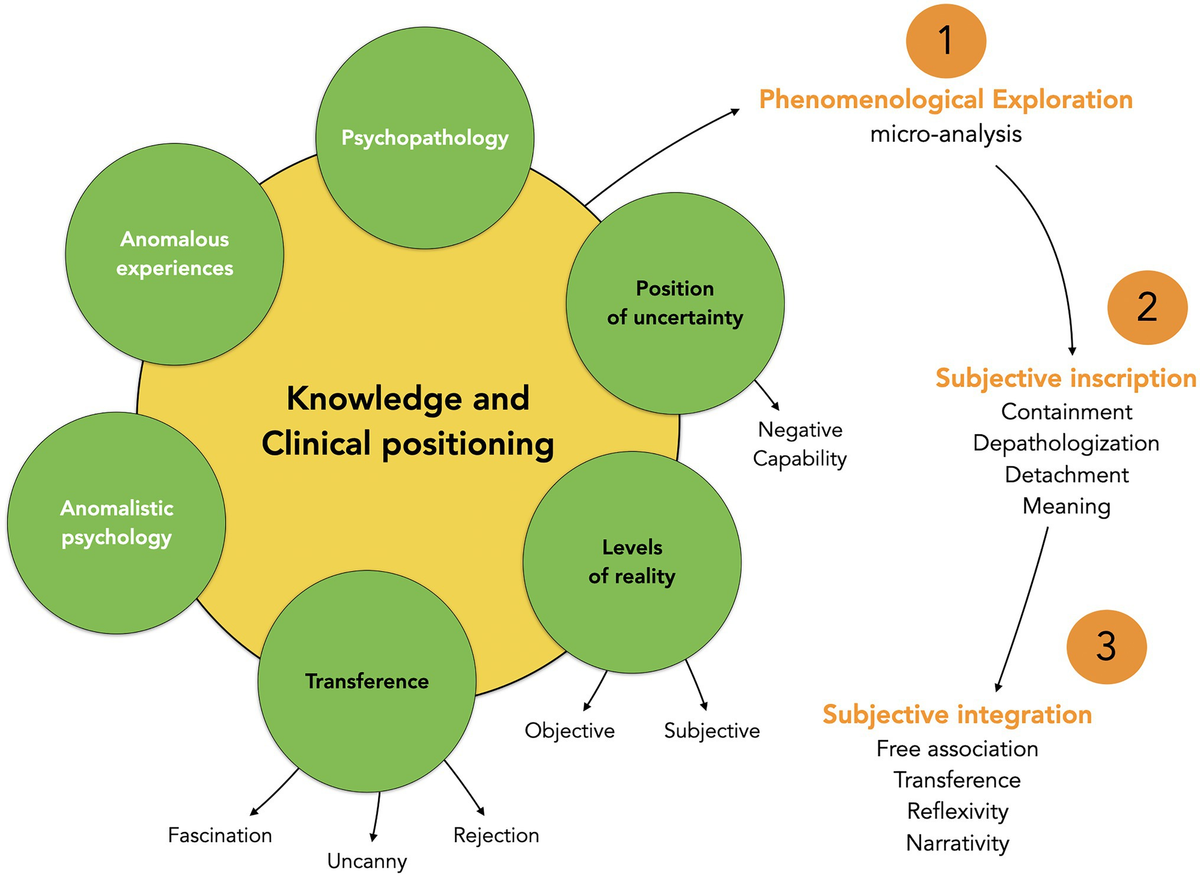
Somewhere between a third and half of all people report paranormal-type experiences — seeing ghosts, sensing the future, feeling a mysterious presence — and nearly half of those folks find the experience genuinely distressing. So where do they turn for help? Most therapists have zero training for this. A clinic called CIRCEE (with over 750 counseling sessions under its belt) developed an approach called PPAE that threads a clever needle: therapists neither dismiss these experiences as delusion nor accept them uncritically. Instead, they explore what happened in fine detail, help the person process the emotional shock, and work toward making personal meaning from it. The key clinical stance is "undecidability" — staying genuinely open rather than judging whether the experience was "real." It is a refreshingly humane framework that treats the person's distress as valid regardless of what caused it.
Abstract
In this paper, we propose a clinical approach to the counseling of distressing subjective paranormal experiences, usually referred to as anomalous or exceptional experiences in the academic field. These experiences are reported by a large part of the population, yet most mental health practitioners have not received a specific training in listening constructively to these experiences. This seems all the more problematic since nearly one person in two find it difficult to integrate such experiences, which can be associated with different forms of psychological suffering. After having described briefly several clinical approaches already developed in this area, we outline the main aspects of clinical practice with people reporting exceptional experiences, in particular the characteristics of the clinician's attitude toward the narrative of unusual events. We then present the core components of a Psychodynamic Psychotherapy focused on Anomalous Experiences (PPAE) based on three main steps: phenomenological exploration, subjective inscription and subjective integration of the anomalous experience. Such an approach, based on a non-judgmental and open listening, favors the transformation of the ontological shock that often follows the anomalous experiences into a potential source of integration and psychological transformation.
Links
Related Papers
Cites
Also by these authors
A Preregistered Multi-Lab Replication of Maier et al. (2014, Exp. 4) Testing Retroactive Avoidance
Why Most Research Findings About Psi Are False: The Replicability Crisis, the Psi Paradox and the Myth of Sisyphus
Feeling the Future: A Meta-Analysis of 90 Experiments on the Anomalous Anticipation of Random Future Events
More in Overview
Editorial: Emerging Research: Self-Ascribed Parapsychological Abilities
What if consciousness is not an emergent property of the brain? Observational and empirical challenges to materialistic models
Is the Sun Conscious?
Inner Experience – Direct Access to Reality: A Complementarist Ontology and Dual Aspect Monism Support a Broader Epistemology
The Experimental Evidence for Parapsychological Phenomena: A Review
📋 Cite this paper
Rabeyron, Thomas (2022). When the Truth Is Out There: Counseling People Who Report Anomalous Experiences. Frontiers in Psychology. https://doi.org/10.3389/fpsyg.2021.693707
@article{kramer_2022_counseling_anomalous,
  title = {When the Truth Is Out There: Counseling People Who Report Anomalous Experiences},
  author = {Rabeyron, Thomas},
  year = {2022},
  journal = {Frontiers in Psychology},
  doi = {10.3389/fpsyg.2021.693707},
}