📌 Appears in:
Plain English Summary
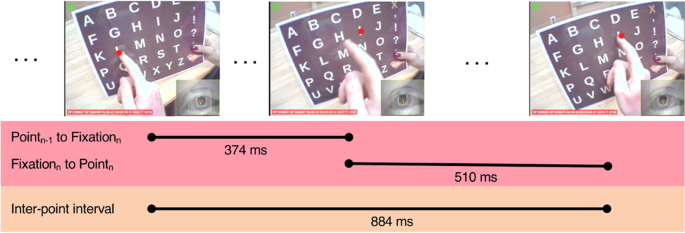
Can nonspeaking autistic people really author their own messages when pointing to letters on a board, or is someone secretly guiding them? This study tackled that explosive question with hard data. Nine nonspeaking autistic young adults wore eye-tracking headsets while answering questions via a hand-held letterboard. Results were striking: letter accuracy hit 94%, and their eyes landed on the correct letter before their finger did about 71% of the time — by nearly half a second. You simply cannot explain that as the assistant cueing them. Their spelling timing also mirrored fluent non-autistic typists: longer pauses between words, faster movement through common letter pairs. This is the first objective eye-tracking evidence that these communicators genuinely author their messages — directly challenging organizations that dismiss all letterboard communication as facilitator-controlled.
Abstract
About one-third of autistic people have limited ability to use speech. Some have learned to communicate by pointing to letters of the alphabet. But this method is controversial because it requires the assistance of another person—someone who holds a letterboard in front of users and so could theoretically cue them to point to particular letters. Indeed, some scientists have dismissed the possibility that any nonspeaking autistic person who communicates with assistance could be conveying their own thoughts. In the study reported here, we used head-mounted eye-tracking to investigate communicative agency in a sample of nine nonspeaking autistic letterboard users. We measured the speed and accuracy with which they looked at and pointed to letters as they responded to novel questions. Participants pointed to about one letter per second, rarely made spelling errors, and visually fixated most letters about half a second before pointing to them. Additionally, their response times reflected planning and production processes characteristic of fluent spelling in non-autistic typists. These findings render a cueing account of participants' performance unlikely: The speed, accuracy, timing, and visual fixation patterns suggest that participants pointed to letters they selected themselves, not letters they were directed to by the assistant. The blanket dismissal of assisted autistic communication is therefore unwarranted.
Links
Related Papers
Companion
Same Research Program
More in Nonverbal
📋 Cite this paper
Jaswal, Vikram K, Wayne, Allison, Golino, Hudson (2020). Eye-Tracking Reveals Agency in Assisted Autistic Communication. Scientific Reports. https://doi.org/10.1038/s41598-020-64553-9
@article{jaswal_2020_eyetracking,
  title = {Eye-Tracking Reveals Agency in Assisted Autistic Communication},
  author = {Jaswal, Vikram K and Wayne, Allison and Golino, Hudson},
  year = {2020},
  journal = {Scientific Reports},
  doi = {10.1038/s41598-020-64553-9},
}