Near-Death Experiences in Non-Life-Threatening Events and Coma of Different Etiologies
📄 Original study ↗📌 Appears in:
Plain English Summary
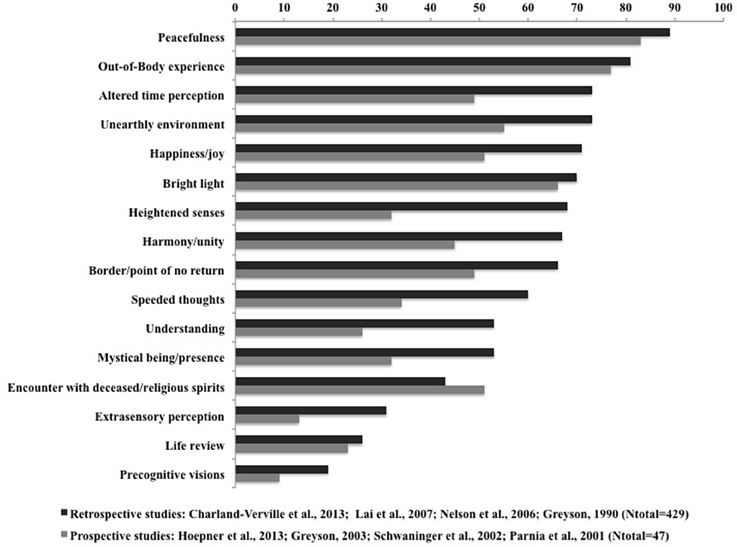
Here's a brain-twister: people who were never actually close to death report near-death experiences that are statistically indistinguishable from those of people who genuinely almost died. This large study compared 190 NDE reports — 50 from folks who had NDE-like experiences during sleep, fainting, or meditation, and 140 from coma survivors. Using a standardized scoring system, both groups reported the same intensity and the same features. Peacefulness dominated (around 90%), and barely anyone had a negative experience. That's a real puzzle for theories claiming NDEs are just the dying brain malfunctioning — if your brain doesn't need to be dying to produce the same experience, what's really going on? One methodological wrinkle worth noting: when people recall NDEs long after the fact, they report more features overall than in studies done right after the event, except for encounters with deceased loved ones, which actually show up more in immediate accounts.
Abstract
Background: Near death experiences (NDEs) are increasingly being reported as a clearly identifiable physiological and psychological reality of clinical significance. However, the definition and causes of the phenomenon as well as the identification of NDE experiencers is still a matter of debate. To date, the most widely used standardized tool to identify and characterize NDEs in research is the Greyson NDE scale. Using this scale, retrospective and prospective studies have been trying to estimate their incidence in various populations but few studies have attempted to associate the experiences' intensity and content to etiology. Methods: This retrospective investigation assessed the intensity and the most frequently recounted features of self-reported NDEs after a non-life-threatening event (i.e., "NDE-like" experience) or after a pathological coma (i.e., "real NDE") and according to the etiology of the acute brain insult. We also compared our retrospectively acquired data in anoxic coma with historical data from the published literature on prospective post-anoxic studies using the Greyson NDE scale. Results: From our 190 reports who met the criteria for NDE (i.e., Greyson NDE scale total score > 7/32), intensity (i.e., Greyson NDE scale total score) and content (i.e., Greyson NDE scale features) did not differ between "NDE-like" (n = 50) and "real NDE" (n = 140) groups, nor within the "real NDE" group depending on the cause of coma (anoxic/traumatic/other). The most frequently reported feature was peacefulness (89–93%). Only 2 patients (1%) recounted a negative experience. The overall NDE core features' frequencies were higher in our retrospective anoxic cohort when compared to historical published prospective data. Conclusions: It appears that "real NDEs" after coma of different etiologies are similar to "NDE-like" experiences occurring after non-life threatening events. Subjects reporting NDEs retrospectively tend to have experienced a different content compared to the prospective experiencers. Keywords: Near-death experiences, Greyson NDE scale, coma, cardiac arrest, traumatic brain injury, memory, non-life threatening events
Links
Related Papers
Same Research Program
- Characteristics of Near-Death Experiences Memories as Compared to Real and Imagined Events Memories — Thonnard, Marie (2013)
- Temporality of Features in Near-Death Experience Narratives — Martial, Charlotte (2017)
- Qualitative thematic analysis of the phenomenology of near-death experiences — Cassol, Helena (2018)
- A systematic analysis of distressing near-death experience accounts — Cassol, Helena (2019)
Cited By
- The Central Clinical Relevance of Near-Death Experiences in Acute Care Contexts — Michael, Pascal (2025)
- Neuro-Functional Modeling of Near-Death Experiences in Contexts of Altered States of Consciousness — Romand, Raymond (2023)
- Explanation of Near-Death Experiences: A Systematic Analysis of Case Reports and Qualitative Research — Hashemi, Amirhossein (2023)
More in Nde
AWAreness during REsuscitation - II: A Multi-Center Study of Consciousness and Awareness in Cardiac Arrest
Which Near-Death Experience Features Are Associated with Reduced Fear of Death?
Advancing the Evidence for Survival of Consciousness
The Mystical Experience and Its Neural Correlates
The Near-Death Experience Content (NDE-C) scale: Development and psychometric validation
📋 Cite this paper
Charland-Verville, V, Jourdan, J.P, Thonnard, M, Ledoux, D, Donneau, A.F, Quertemont, E, Laureys, S (2014). Near-Death Experiences in Non-Life-Threatening Events and Coma of Different Etiologies. Frontiers in Human Neuroscience. https://doi.org/10.3389/fnhum.2014.00203
@article{charland_verville_2014_nde_non_life_threatening,
  title = {Near-Death Experiences in Non-Life-Threatening Events and Coma of Different Etiologies},
  author = {Charland-Verville, V and Jourdan, J.P and Thonnard, M and Ledoux, D and Donneau, A.F and Quertemont, E and Laureys, S},
  year = {2014},
  journal = {Frontiers in Human Neuroscience},
  doi = {10.3389/fnhum.2014.00203},
}